 Add to Chrome
 Add to Firefox
 Add to Edge
Why Larger Models Learn More: Effects of Capacity, Interference, and Rare-Task Retention
May 28, 2026
Larger models learn tasks smaller models do not. What drives this phenomenon? We develop a simple phenomenological argument that power-law scaling already suggests that a larger model will be able to learn a part of the data distribution that a smaller model fails to learn, even with infinite training data. To validate this claim and identify its causes, we study the effects of model scaling on a synthetic setup consisting of a mixture of tasks that show monotonic scaling curves. The results point to a data-induced competition over resources (neurons). Specifically, smaller models allocate their neurons to high frequency or low complexity tasks, and so they learn solutions that perform poorly on rare and complex tasks. Moreover, this happens even when solutions capable of expressing the desired task exist. We then assess how a larger model circumvents this data-centric bottleneck, finding that it traces to a reduced interference mechanism: larger models can allocate enough resources to common tasks that the gradient updates for those tasks become weak, which means that they do not overwrite rare-task features as they slowly accumulate. Finally, to further validate these claims, we pretrain OLMo models (4M to 4B parameters) on novel tasks of varying frequency and complexity. The results mirror those from our synthetic data experiments: only the larger OLMo models learn the infrequent and complex tasks, and these larger models embed more task features in their representations and show less gradient interference between tasks. Overall, we offer a data-centric account of why larger models learn tasks that smaller models fail to. This helps explain why larger models are better in practice, and it can inform practical questions concerning model sizing and training data mixtures.

Stories in Space: In-Context Learning Trajectories in Conceptual Belief Space
May 12, 2026Large Language Models (LLMs) update their behavior in context, which can be viewed as a form of Bayesian inference. However, the structure of the latent hypothesis space over which this inference operates remains unclear. In this work, we propose that LLMs assign beliefs over a low-dimensional geometric space - a conceptual belief space - and that in-context learning corresponds to a trajectory through this space as beliefs are updated over time. Using story understanding as a natural setting for dynamic belief updating, we combine behavioral and representational analyses to study these trajectories. We find that (1) belief updates are well-described as trajectories on low-dimensional, structured manifolds; (2) this structure is reflected consistently in both model behavior and internal representations and can be decoded with simple linear probes to predict behavior; and (3) interventions on these representations causally steer belief trajectories, with effects that can be predicted from the geometry of the conceptual space. Together, our results provide a geometric account of belief dynamics in LLMs, grounding Bayesian interpretations of in-context learning in structured conceptual representations.
Manifold Steering Reveals the Shared Geometry of Neural Network Representation and Behavior
May 06, 2026Neural representations carry rich geometric structure; but does that structure causally shape behavior? To address this question, we intervene along paths through activation space defined by different geometries, and measure the behavioral trajectories they induce. In particular, we test whether interventions that respect the geometry of activation space will yield behaviors close to those the model exhibits naturally. Concretely, we first fit an activation manifold $M_h$ to representations and a behavior manifold $M_y$ to output probability distributions. We then test the link $M_h \leftrightarrow M_y$ via interventions: we find that steering along $M_h$, which we term manifold steering, yields behavioral trajectories that follow $M_y$, while linear steering -- which assumes a Euclidean geometry -- cuts through off-manifold regions and hence produces unnatural outputs. Moreover, optimizing interventions in activation space to produce paths along $M_y$ recovers activation trajectories that trace the curvature of $M_h$. We demonstrate this bidirectional relationship between the geometry of representation and behavior across tasks and modalities. In language models, we use reasoning tasks with cyclic and sequential geometries as well as in-context learning tasks with more complex graph geometries. In a video world model, we use a task with geometry corresponding to physical dynamics. Overall, our work shows that geometry in neural representation is not merely incidental, but is in fact the proper object for enabling principled control via intervention on internals. This recasts the core problem of steering from finding the right direction to finding the right geometry.
Features as Rewards: Scalable Supervision for Open-Ended Tasks via Interpretability
Feb 11, 2026Language models trained on large-scale datasets have been shown to learn features that encode abstract concepts such as factuality or intent. Such features are traditionally used for test-time monitoring or steering. We present an alternative affordance: features as scalable supervision for open-ended tasks. We consider the case of hallucination-reduction as a desirable, yet open-ended behavior and design a reinforcement learning (RL) pipeline, titled RLFR (Reinforcement Learning from Feature Rewards), that uses features as reward functions. Grounded in a novel probing framework that identifies candidate hallucinated claims, our pipeline teaches a model to intervene and correct its completions when it is uncertain of their factuality. Furthermore, the pipeline enables scalable test-time compute, guided once more by our reward features. This end-to-end process operationalized on Gemma-3-12B-IT results in a policy that is 58% less likely to hallucinate compared to the original model (when run in tandem with our probing harness), while preserving performance on standard benchmarks. Taken together, by grounding supervision in the language of features, this paper introduces a novel paradigm in the use of interpretability for learning open-ended tasks.
The Shape of Beliefs: Geometry, Dynamics, and Interventions along Representation Manifolds of Language Models' Posteriors
Feb 02, 2026Large language models (LLMs) represent prompt-conditioned beliefs (posteriors over answers and claims), but we lack a mechanistic account of how these beliefs are encoded in representation space, how they update with new evidence, and how interventions reshape them. We study a controlled setting in which Llama-3.2 generates samples from a normal distribution by implicitly inferring its parameters (mean and standard deviation) given only samples from the distribution in context. We find representations of curved "belief manifolds" for these parameters form with sufficient in-context learning and study how the model adapts when the distribution suddenly changes. While standard linear steering often pushes the model off-manifold and induces coupled, out-of-distribution shifts, geometry and field-aware steering better preserves the intended belief family. Our work demonstrates an example of linear field probing (LFP) as a simple approach to tile the data manifold and make interventions that respect the underlying geometry. We conclude that rich structure emerges naturally in LLMs and that purely linear concept representations are often an inadequate abstraction.
From Isolation to Entanglement: When Do Interpretability Methods Identify and Disentangle Known Concepts?
Dec 17, 2025A central goal of interpretability is to recover representations of causally relevant concepts from the activations of neural networks. The quality of these concept representations is typically evaluated in isolation, and under implicit independence assumptions that may not hold in practice. Thus, it is unclear whether common featurization methods - including sparse autoencoders (SAEs) and sparse probes - recover disentangled representations of these concepts. This study proposes a multi-concept evaluation setting where we control the correlations between textual concepts, such as sentiment, domain, and tense, and analyze performance under increasing correlations between them. We first evaluate the extent to which featurizers can learn disentangled representations of each concept under increasing correlational strengths. We observe a one-to-many relationship from concepts to features: features correspond to no more than one concept, but concepts are distributed across many features. Then, we perform steering experiments, measuring whether each concept is independently manipulable. Even when trained on uniform distributions of concepts, SAE features generally affect many concepts when steered, indicating that they are neither selective nor independent; nonetheless, features affect disjoint subspaces. These results suggest that correlational metrics for measuring disentanglement are generally not sufficient for establishing independence when steering, and that affecting disjoint subspaces is not sufficient for concept selectivity. These results underscore the importance of compositional evaluations in interpretability research.
Are language models aware of the road not taken? Token-level uncertainty and hidden state dynamics
Nov 06, 2025When a language model generates text, the selection of individual tokens might lead it down very different reasoning paths, making uncertainty difficult to quantify. In this work, we consider whether reasoning language models represent the alternate paths that they could take during generation. To test this hypothesis, we use hidden activations to control and predict a language model's uncertainty during chain-of-thought reasoning. In our experiments, we find a clear correlation between how uncertain a model is at different tokens, and how easily the model can be steered by controlling its activations. This suggests that activation interventions are most effective when there are alternate paths available to the model -- in other words, when it has not yet committed to a particular final answer. We also find that hidden activations can predict a model's future outcome distribution, demonstrating that models implicitly represent the space of possible paths.
How Do LLMs Persuade? Linear Probes Can Uncover Persuasion Dynamics in Multi-Turn Conversations
Aug 07, 2025Large Language Models (LLMs) have started to demonstrate the ability to persuade humans, yet our understanding of how this dynamic transpires is limited. Recent work has used linear probes, lightweight tools for analyzing model representations, to study various LLM skills such as the ability to model user sentiment and political perspective. Motivated by this, we apply probes to study persuasion dynamics in natural, multi-turn conversations. We leverage insights from cognitive science to train probes on distinct aspects of persuasion: persuasion success, persuadee personality, and persuasion strategy. Despite their simplicity, we show that they capture various aspects of persuasion at both the sample and dataset levels. For instance, probes can identify the point in a conversation where the persuadee was persuaded or where persuasive success generally occurs across the entire dataset. We also show that in addition to being faster than expensive prompting-based approaches, probes can do just as well and even outperform prompting in some settings, such as when uncovering persuasion strategy. This suggests probes as a plausible avenue for studying other complex behaviours such as deception and manipulation, especially in multi-turn settings and large-scale dataset analysis where prompting-based methods would be computationally inefficient.
Uncovering Conceptual Blindspots in Generative Image Models Using Sparse Autoencoders
Jun 24, 2025Despite their impressive performance, generative image models trained on large-scale datasets frequently fail to produce images with seemingly simple concepts -- e.g., human hands or objects appearing in groups of four -- that are reasonably expected to appear in the training data. These failure modes have largely been documented anecdotally, leaving open the question of whether they reflect idiosyncratic anomalies or more structural limitations of these models. To address this, we introduce a systematic approach for identifying and characterizing "conceptual blindspots" -- concepts present in the training data but absent or misrepresented in a model's generations. Our method leverages sparse autoencoders (SAEs) to extract interpretable concept embeddings, enabling a quantitative comparison of concept prevalence between real and generated images. We train an archetypal SAE (RA-SAE) on DINOv2 features with 32,000 concepts -- the largest such SAE to date -- enabling fine-grained analysis of conceptual disparities. Applied to four popular generative models (Stable Diffusion 1.5/2.1, PixArt, and Kandinsky), our approach reveals specific suppressed blindspots (e.g., bird feeders, DVD discs, and whitespaces on documents) and exaggerated blindspots (e.g., wood background texture and palm trees). At the individual datapoint level, we further isolate memorization artifacts -- instances where models reproduce highly specific visual templates seen during training. Overall, we propose a theoretically grounded framework for systematically identifying conceptual blindspots in generative models by assessing their conceptual fidelity with respect to the underlying data-generating process.
Detecting High-Stakes Interactions with Activation Probes
Jun 12, 2025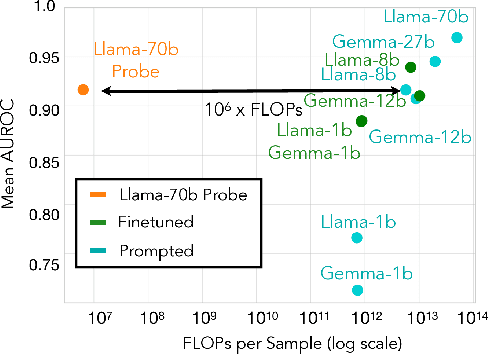
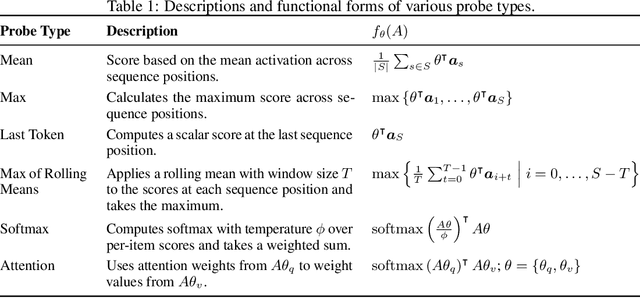

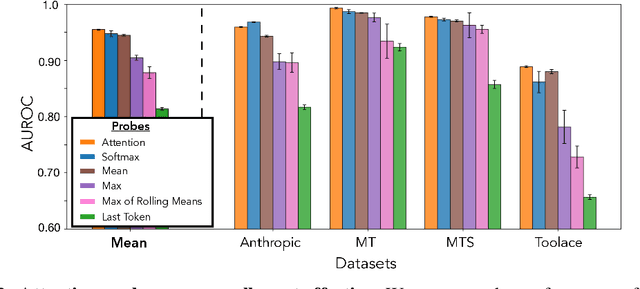
Monitoring is an important aspect of safely deploying Large Language Models (LLMs). This paper examines activation probes for detecting "high-stakes" interactions -- where the text indicates that the interaction might lead to significant harm -- as a critical, yet underexplored, target for such monitoring. We evaluate several probe architectures trained on synthetic data, and find them to exhibit robust generalization to diverse, out-of-distribution, real-world data. Probes' performance is comparable to that of prompted or finetuned medium-sized LLM monitors, while offering computational savings of six orders-of-magnitude. Our experiments also highlight the potential of building resource-aware hierarchical monitoring systems, where probes serve as an efficient initial filter and flag cases for more expensive downstream analysis. We release our novel synthetic dataset and codebase to encourage further study.